
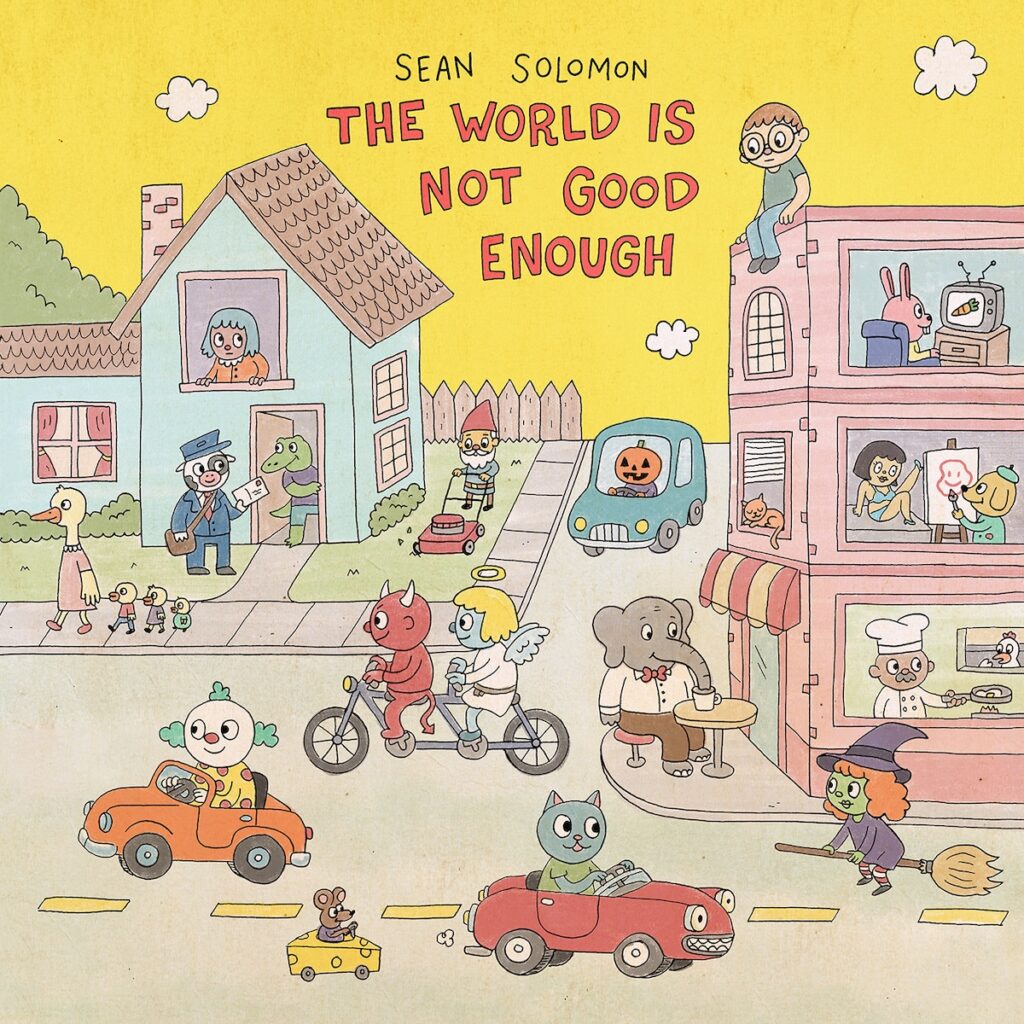
The cover of Sean Solomon’s solo debut features humanlike cartoon animals, drawn by the artist himself. Solomon, who has previously provided animation for videos by Odd Future and Run the Jewels, adopts a style reminiscent of children’s author Richard Scarry. Scarry’s work, which defined the fictional metropolis of Busytown for a generation, serves as a curious visual anchor for Solomon’s latest musical endeavor. While Solomon’s animation style leans toward the surreal and twisted—evoking the sensibilities of Daniel Clowes and Lisa Hanawalt—there remains a covert whimsicality, suggesting that the innocence of Huckle Cat and Lowly Worm is still buried somewhere beneath the surface.
As a singer-songwriter, the Los Angeles-based musician favors disillusion over delirium. His narrators are often dissatisfied and weary, yet they carry a shred of vulnerability that keeps their humanity intact. This marks a distinct shift from his tenure leading the crunchy rock band Moaning, who were last heard exploring a decadent new wave direction on their 2020 Sub Pop album, Uneasy Laughter.
A Shift in Sound
On The World Is Not Good Enough, Solomon lightens his tone, singing in a higher register with a yolky timbre that feels akin to a more grounded Daniel Johnston. He sticks to a clean, colorful folk palette where guitars are mostly distortion-free and firmly strummed. The tempos rarely push beyond an easy canter, and the percussion remains steady rather than flashy. While fellow Angelenos Shannon Lay and Sofia Arreguin contribute guitar, vocals, and violin, they remain firmly in the background, allowing Solomon’s vision to take center stage.
Solomon’s work reflects a deep study of the indie moves of the 2000s. Listeners will hear traces of the era’s heavy hitters: the mellow trumpet and buzzing synth on “Car Crash” recall the Elephant 6 collective, while the abrupt, swooping choruses of “Shooting Star” and “Postcard” echo the grandeur of Arcade Fire. The driving, syncopated arpeggio of “Remember” even owes a debt to Pinback. Throughout the record, the ghost of Elliott Smith hangs over the arrangements, biting its spectral nails.
Finding Resolve in Disillusion
Despite these influences, Solomon’s music is far from a mere collection of homages. His voice possesses a steady resolve, avoiding the quavering hesitation often found in his sad-sack predecessors. There is a central toughness to his work that keeps drama and extravagance to a minimum. Even on the most despairing tracks, Solomon refuses to play the role of the perpetual victim.
On “Black Hole,” a song that offers a straightforward look at depression and cyclical dysfunction, Solomon sings: “My heart breaks / when you make the face / Like father, like son / What have I become?” Rather than sinking into inherited misery, he pivots to a statement of independence: “I love you / You don’t have to love me too!” It is not exactly an affirmation, but as a statement of vulnerable connection, it serves as a powerful conclusion to his exploration of a busy, messed-up world.