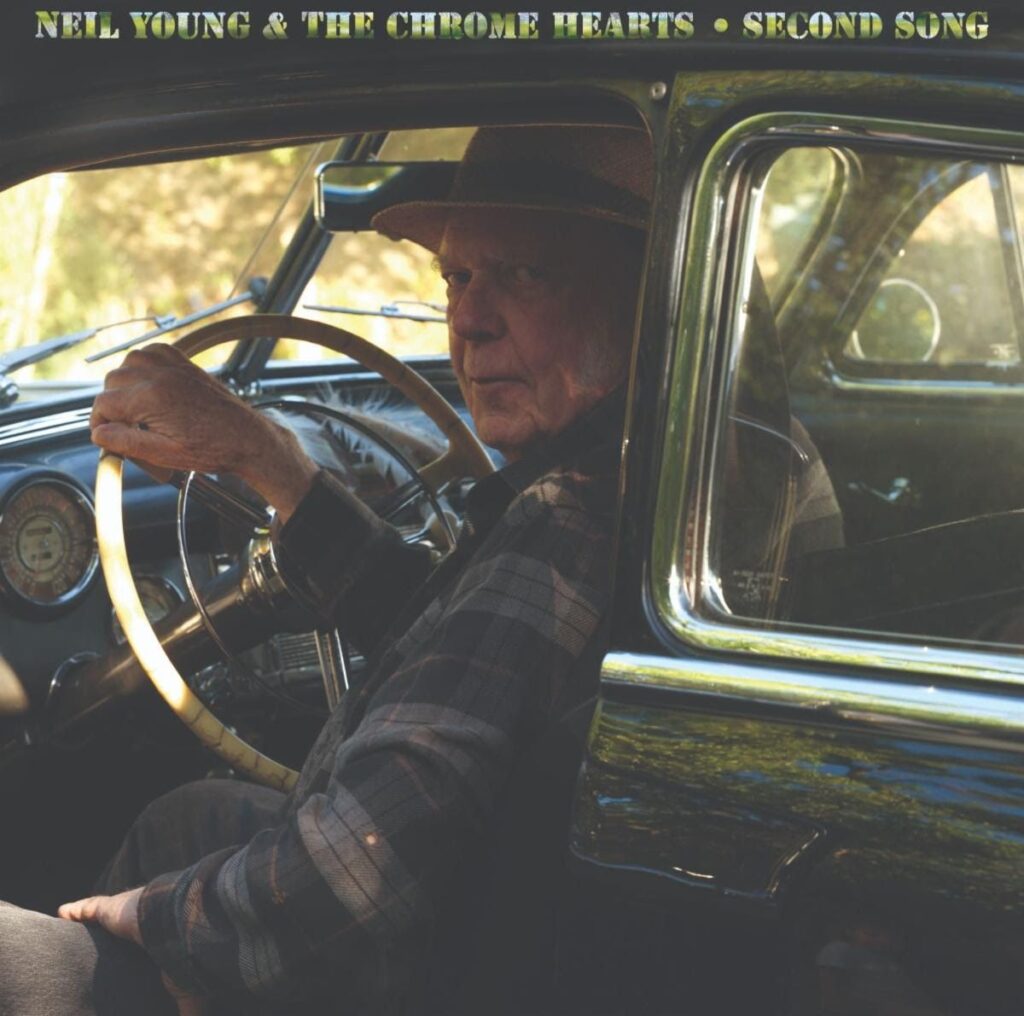
Second Song is an act of hypnosis. For all of Neil Young’s enduring and endlessly regenerative influence, that power is what nobody can touch. Imitate his moody, mewing Canadian whine; adopt his verité approach to studio recording; tune your acoustic guitar to drop-D and overdrive your electric through a vintage amp; rip a solo that’s just one note and dig into the fretboard as if a weaker player handed you their instrument to help wear in the neck. But who else can conjure this kind of grainy, autumnal dream state with such effortlessness and patience, using such spare tools? For the first time since 2012’s louder and gnarlier Psychedelic Pill, Young spends his 50th studio album luxuriating in this gift, casting a glow of bittersweet contentment that feels distinct in his catalog.
You could be forgiven for keeping your expectations low. These days, the 80-year-old songwriter’s attention seems largely dominated by his Archives project—the type of comprehensive legacy curation that tends to be handed off entirely to the label but which Young has continued to operate in a charmingly messy state of constant, unpredictable motion. Along the way, his new records, more than ever, seem to exist mainly to document passing obsessions, feelings, and company. From a trio of understated Crazy Horse reunion records between 2019 and 2022 to last year’s wispy and unsteady Talkin to the Trees—the debut of his new backing band, the Chrome Hearts—these statements are always welcome but rarely essential.
A Meditative Approach to Songcraft
Upon entering the studio earlier this year, even Young wasn’t sure about his latest crop of material, confessing to Archives subscribers that he “ran out of tunes fast.” Really, he just had five songs—and “songs” might even be stretching it. These were slow, formless meditations, several hovering around the 10-minute mark, ambling along to breezy, familiar chord changes on acoustic guitar and piano. The title track felt like a stretched-out jam on the ascending progression from his eternal “Harvest Moon”; another sounded a little like Mazzy Starr’s “Fade Into You.” And so, Young padded out the record with new renditions of “Casting Me Away From You” and “I’ll Love You Forever,” two early rarities that had yet to appear on a studio album. Together, they lighten up the B-side of the record with sweet, Beatlesque love songs: nascent tunes written by a young singer-songwriter in the mid ’60s, finding his voice in a crowded industry.
Here, they serve a different purpose. For one thing, they are reminders of the melodic dexterity that once defined Young’s songwriting but has since been replaced with a first-thought-best-thought folk simplicity. There’s another thing that’s hard to replicate: While “Casting Me Away From You” might feel like a pop standard, notice the way the rhythm shifts briefly, allowing the turn of “Now I find/You’re leaving me behind” to form its own mini-refrain within the chorus. On Talkin to the Trees, you got the sense the Chrome Hearts were hearing the songs for the first time as Neil counted off; now, you can sense his bandmates listening, cautiously finding their way and navigating each turn with a fragility that suits the material.
Atmosphere and Reflection
So, too, does Young’s voice. The music on Second Song seems built to spotlight the weathered yelps of his falsetto, frayed at the edges and finally showing his age after a lifetime of sounding wise beyond his years. The record I think of most upon listening is 1994’s Sleeps With Angels, which carved a haunted middle ground between the unruly jams of Ragged Glory and the twilight balladry of Harvest Moon. Like that record, this one is more notable for sustaining an atmosphere than contributing any individual staples to his songbook. “Day After Day,” the song that resembles “Fade Into You,” is gorgeous and wistful, delivered with a steady insistence that feels as intense as any of Young’s heavier epics. But now the goal is eliciting a sense of quiet focus: “There’s something I want to say and say it slow,” he tells us. “I’m a little scared of it… so here it goes.”
It’s hard to imagine what Young, at this stage in his career, may be intimidated to reveal—especially considering, just an album ago, he was unloading family drama with uncomfortable specifics about his estranged daughter. This time, he assumes a more generous perspective. My favorite lyric arrives in the nine-minute “Soon I Might Be Going.” As if floating past a timeline that begins with those once-abandoned songs from the ’60s, he speeds up to the present day, as he watches the news in disbelief and assesses concerning changes in the weather and environment. Then, he turns his attention back to his daughter: “I miss you like tomorrow,” he sings. “And I see you like today.”
Such a simple idea, but no other songwriter could make it mean so much. With the foghorning drone of a distorted electric guitar beneath his acoustic strumming, Young seems to condense his worldview, his creative process, and his anxieties into these fleeting words. Here is the promise that has kept him running all these years: a new day, another batch of songs, some more perspective on the miles he’s traveled. As he comes to grips with a finite amount of tomorrows, he’s helping to prolong the beauty and meaning of today.