
I started this complicated story in my living room back home in Pennsylvania in the fall of 2023, staring at a giant tiger head on my computer screen, letting it sink in that I had just gotten into Princeton. I had a lot of emotions running through me, chiefly disbelief. Sure, it meant that the work I had put in during high school had paid off, but it wasn’t my work that meant the most to me. What my acceptance signified, more importantly, was that the struggle of my parents was showing some of its fruit.
My family had suffered enormously during the Liberian conflicts of the 1990s. I knew that I wanted to use my education to help Africa and struggling nations like it, and I was ecstatic at the resources Princeton was offering me to do so. My parents were even more overjoyed, and not just because of the generous financial aid I would receive. When my father came to the United States after fleeing Liberia’s Second Civil War, he had an uphill battle toward raising a son he would send off to the U.S. News Number One-ranked university in the country.
The Intersection of Academia and Exploitation
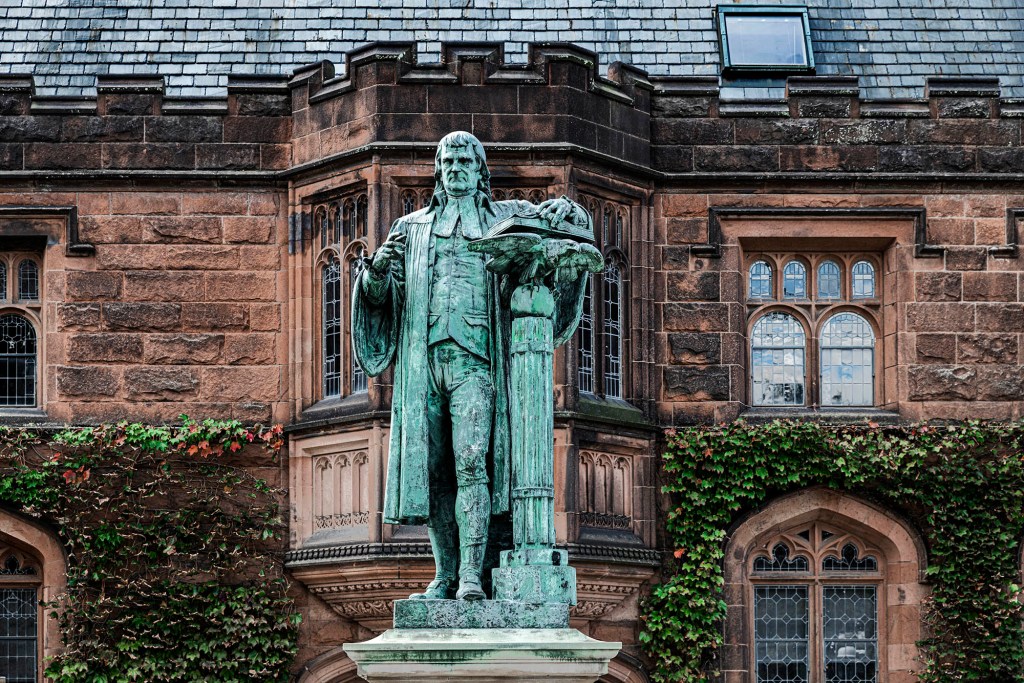
During my sophomore year, I enrolled in a journalism class reporting on a 19th-century story of trafficked slaves sent from Key West to West Africa. Ten weeks into the semester, the class met Dr. Artemus Gaye, a scholar and activist from Monrovia. He took us on a tour of Princeton’s grounds, speaking about its deep connections to Liberia. We stood before the statue of John Witherspoon, the university president who was also a slaveowner, and then moved to Firestone Plaza.
While students know Firestone Library as a place for study, for Dr. Gaye, the name carries a heavy history. His family worked on the Firestone plantation in Harbel, the largest contiguous rubber farm in the world. His cousin, Nathan, recalled the rancid smell of burning rubber and the $10 monthly wages that paid for the very library stacks where we now study.
The Legacy of the American Colonization Society
In his book Empire of Rubber, historian Gregg Mitman notes that the history of Liberia is inextricably linked to the plantation system. Founded by the American Colonization Society (ACS), Liberia was intended as a haven for the formerly enslaved, yet it functioned as a deportation scheme driven by white supremacy. Many early ACS leaders were Princeton affiliates, including Charles Mercer and Robert F. Stockton, who famously seized land from the indigenous Dei people at gunpoint.
Reckoning with the Past
By 1926, the Firestone Rubber Company acquired one million acres of Liberian land for pennies. This exploitation fueled the American economy and provided the wealth that eventually funded Princeton’s library. Despite the clear historical record, the university has yet to formally address its relationship with the ACS and the Firestone Company.
I sat down with Professor Eddie Glaude Jr. to discuss these findings. He reminded me of Toni Morrison’s words: “If one cannot use the past, one cannot function in the present, and so one can never be free.” As I plan my own return to Liberia to visit the plantation where my family’s history was forged, I am reminded that remembrance is the only path toward true reconciliation.