
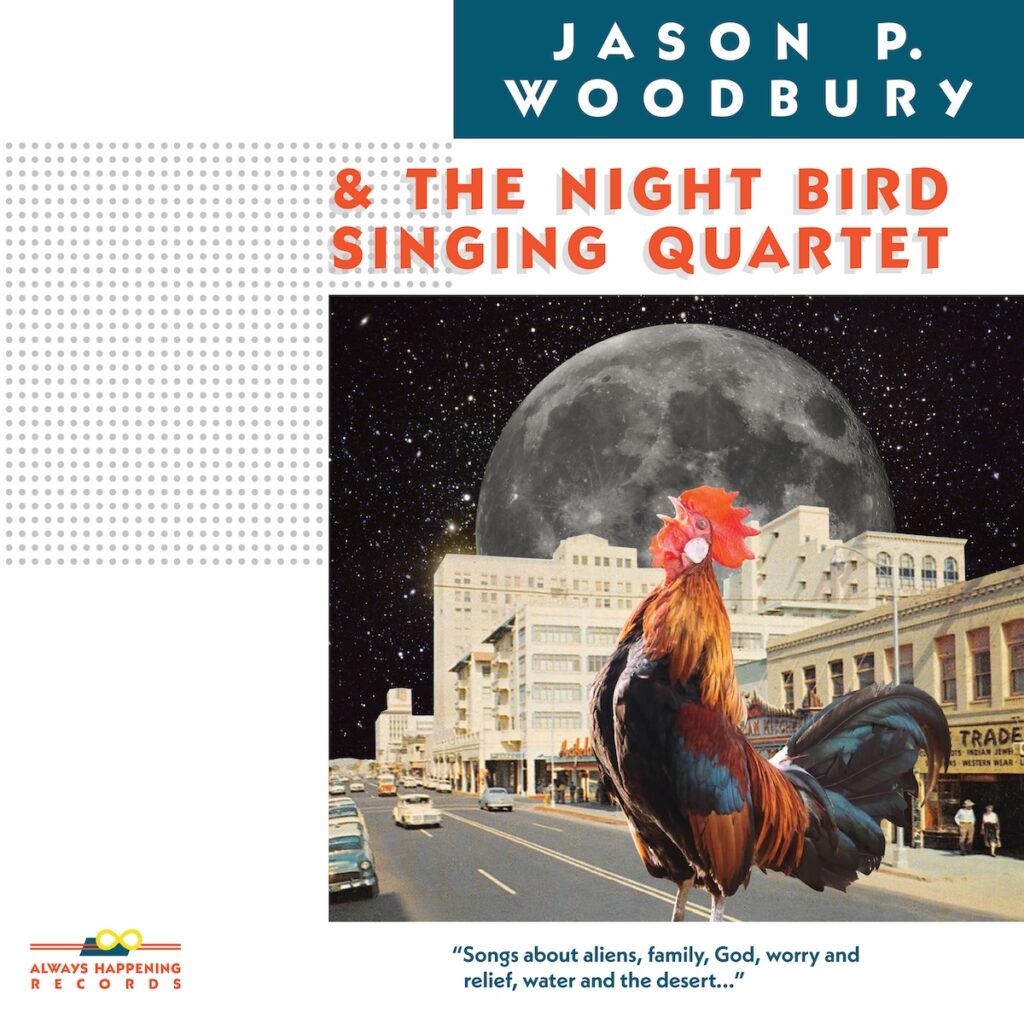
The cover of the self-titled debut from Jason P. Woodbury & the Nightbird Singing Quartet speaks volumes: It’s modeled on the indelible design of Vintage Contemporaries, a 1980s publishing imprint that helped launch such coolly eclectic authors as Barry Hannah, Jay McInerney, Thomas McGuane and Joy Williams, and depicts a rooster crowing on a mid-sized city street, backed by a night sky and an enormous moon. “Nightbird” as a title would fit right in with this literary milieu, and Woodbury’s sharp, stylized sensibility is attuned to musical tradition, as well.
Opening track “Birdsong” sets itself firmly within a particular sound and aesthetic—lots of hazy yet expertly treated reverb balanced by a crisp attention to rhythm, and yearning, panoramic melodies bolstered by atmospheric studio effects: canyon echoes, thunderstorm roars, brushfire crackle. The echo-haunted twang of Rick Heins’ pedal steel and Woodbury’s drifty high-plains tenor reaches toward an astral melancholy even as Andrew Bates’ slouching upright bass and the tactile shuffle of Zachary Toporek’s drums keep things swinging on the ground. Other tracks like “Calling From Somewhere” and “Thunder Deepens” continue to explore this territory—already extensively mapped out by Wilco and My Morning Jacket, among others—mixing muscular mysticism with sweeping, faintly sun-bleached grandeur. It’s an effective formula, worked out with grace and precision.
More from Spin:
- A Noah Kahan Documentary Will Be ‘Out’ Next Month
- Wet Leg, Wolf Alice, Kasabian To Rock ‘SNL UK’
- ‘Demon Hunters,’ ‘Sinners’ Nab Top Oscar Music Honors
Woodbury and his collaborators have so much taste and know-how that they could have hit cruise control and made an entire album of impeccably produced, perfectly enjoyable and largely unchallenging country art-rock. Instead, they go for something more complex and, at times, less appealing on the surface. The first verse of “What Else Is New” has a blunt, harmonically static quality, pounding thunk-thunk piano propping up a deliberately flat vocal melody. But the track’s initial inertia makes the small bursts of guitar squall that punctuate verse two more effective, while the later shift into a handclap-peppered, piano-driven rave-up feels like a full-on revelation. Woodbury’s vocals mirror the music’s combination of epiphany and blasé routine: “Peace surpassing understanding / Yeah, well, what is left to say?” he sings. The answer to that question: Perhaps nothing; maybe everything.
The more colorful “When I Get Lonesome (Again)” carries a similar ambivalence. Riding a hopscotch beat and spun-sugar keys, it sounds more like a parody of a beach party than the genuine article. The chorus leaves the beach for the boardwalk, its cocky doo-wop inflections presenting loneliness less as an inner weakness and more as a loyalty test. Woodbury’s world is full of misdirection, with sincerity masquerading as irony and the real camouflaging itself in the artificial. Epiphanies arrive in the form of common sense, while the obvious is described in prophetic terms. Album closer “The Season Has Arrived” avoids the simplicity of meteorological cycles in favor of something more enigmatic and surreal: redirected helicopters, portals made of muddy river water, “the heart of Christ aflame in your haunted guts.” Over a beat that alternates between driving, shuffling, and lurching, Woodbury sings “Maybe you could make it better or simply slide.” He doesn’t spell out which action he’s going to choose, but the song ends with sampled birdsong, a literal presentation of the opening track’s subject. This time, however, it sounds like the night has ended, the sun is rising, and the birds are waking up.
To see our running list of the top 100 greatest rock stars of all time, click here.