
I was born in 2010 with one foot bent like a penguin’s — a condition commonly known as clubfoot. The conventional wisdom then was to operate, but my specialist, Dr. David Scher at the Hospital for Special Surgery in New York, had a bold idea. Instead of taking a scalpel to my foot, he’d put me in a knee-high cast for a year, and pair that cast with braces worn at night. If all went to plan, I’d have a straight right foot by the time I entered pre-K at four.
Happily, the casting was a big success. I was able to walk, skip, and run without a limp. So, 10 years later, I went back to HSS, hoping to return the favor by volunteering. They’d remade the Pediatrics Ward into a bright blue oval — projected a wall-length, 2D fish-tank with images of “live” fish and hired trained staff to engage sick kids with crafts. The only thing missing was art on the walls, the kind that speaks to kids’ hearts. As a girl who’d grown up obsessed with art — I drew or doodled every spare second, and filled the walls of my girl-cave with paintings — I had a sudden thought: What if I made art specifically for that place, art that lifted kids up at low ebb, and maybe inspired some of them to make their own?
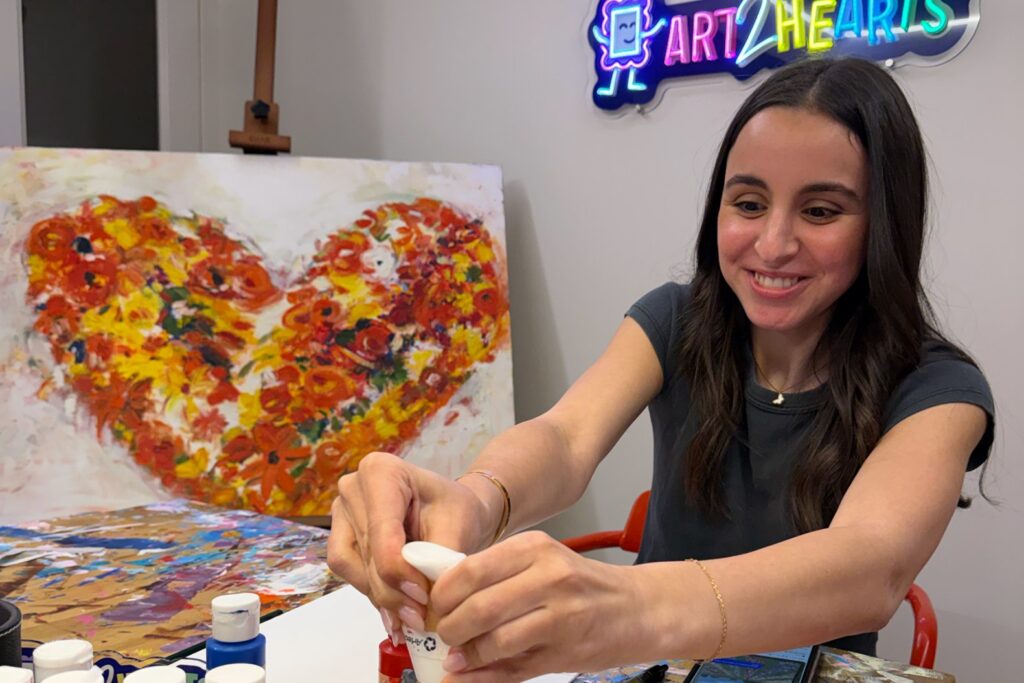
Two years later — to my complete amazement — that idea has become a movement. My paintings, and the ones done by kids I’ve met online, now hang in 22 hospitals in nine countries. And, judging by the flood of art that pours in daily — most of it created by kids on cancer wards — we’ve only just begun to roll up our sleeves.
The Creative Spark
I started doodling and drawing before I could walk — though not before I could talk. I’ve been told I was born talking, which didn’t strike me as a problem, but my friends and family’s mileage varied. My parents had me tested for attention-deficit disorder; my clinical scores were off the charts. The only thing that grounded my buzzing brain was coloring in paper mandalas. Those mandalas soon turned to doodles, the doodles to drawings, and the drawings to paintings — all while I was in grade school. At seven, I started on ADHD medication but still needed to draw or doodle to stay sane.
I bring up my past because it isn’t really past: To this day, I struggle to complete a basic task. When I got the idea to make art for struggling kids, I drove everyone around me nuts with it. One minute, my paintings were going to HSS; the next, to foster homes — no, schools for special-needs kids. For months, I bickered with my folks. They begged me to make a plan and stick with it. Then I met the founder of a brilliant nonprofit. Her name was Danielle Butin, and she’d done an amazing thing: persuaded New York hospitals to give her surplus medical supplies that they otherwise would have dumped in landfills. She rerouted those supplies to crisis zones in Africa, Haiti, and Ukraine, then built her start-up, Afya — Swahili for health — into a pipeline of life-saving goods. Along the way, she created a global community of hospitals, donors and volunteers, all by starting small and staying the course.
Building a Community
At her warehouse in Yonkers, where I was volunteering, I told her about my struggle to launch a start-up. Butin, a former executive in the health-care industry who left in 2007 to launch Afya, listened like a tough but patient mother. She told me it was fine to want to help every sick kid, but to try that from the jump would never fly. “Do one thing first and get good at it,” she said. “And whatever that one thing is, start today.” Only later, when I got better at that thing, should I think about expanding. The other thing that stuck was, I couldn’t do this alone. I had to build a community online.
So, two autumns ago, I started. I made 10 Halloween paintings for HSS. Dancing pumpkins, black cats, smiling witches on broomsticks — I filled 10 canvasses in two days. We brought them down to HSS, hoping for the best, and the staff hung them on the Peds Ward walls. The feedback I got from kids corroborated my hopes that those paintings could lift their spirits.
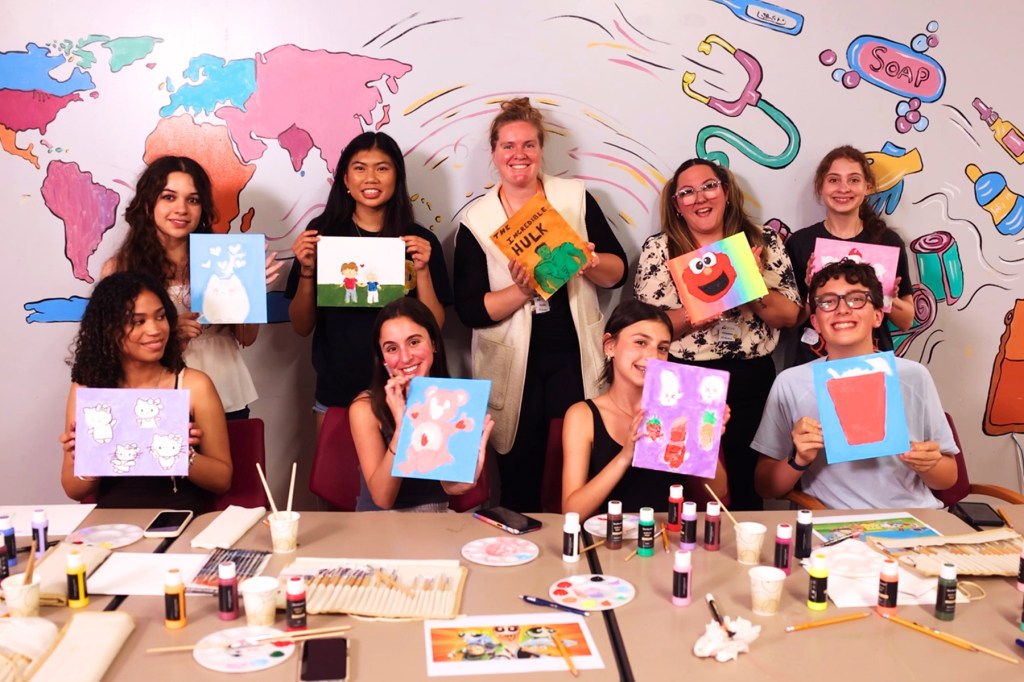
But Danielle was right: I’d never paint enough pictures to make a major impact. I’d need to build a tribe of other artists to supplement the stuff I painted. So as I set about building a website, and a nonprofit called Art2Hearts, I enlisted other kids to paint with me. My first attempt was a total whiff. At a charity night in Westchester, New York, I set up a booth for passersby to paint. Few people stopped, and almost no one painted. That hurt my feelings, but I tried again five months later. My high school sets aside one day a year for student-led events, so I hosted a painting party in my classroom. Dozens of kids came through and painted their hearts out, making 70 pictures in an afternoon. I sent those paintings to five new hospitals, three of them overseas. Not only did the staffers hang them in waiting rooms, they let the children put them up in their rooms.
Last summer, when my website was almost done, I posted a picture of my classmates’ paintings on Instagram. Within minutes, offers came back from people around the world, eager to make pictures for Peds wards. Stunned, I said yes to all of them, then spent a crazed month answering DMs. Paintings by the hundreds came to Afya; we’d arranged with them beforehand to store the art, then send it to new hospitals that signed up.
In October, my Art2Hearts website launched, drenched in bright colors and pillowy graphics. My hope was to build a hub for artists; raising money wasn’t even on my radar. But weeks later, on Giving Tuesday, donations poured in. Over the first four months, we took in $220,000, enough to hire part-time staff to reroute the art to hospitals overseas. We’re now in Korea and South Africa, Israel and Turkey — and what comes in, besides the paintings, are reels and photos from the people painting those pictures.
One of those reels was from a six-year-old girl named Elisa. She suffers from a rare and tenacious form of cancer; it causes tumors to keep growing in her brain. Since the age of two, she’s been in and out of chemo, spending weeks, or sometimes months, at a hospital in Madrid. Each time she goes in, they zap her with poisons that turn her the color of old milk. But for the last several stays, she’s taken the paintings I’ve sent her to hang in her hospital room. She’s also brought along the paintbox and canvases she got from Art2Hearts. In the video she sent me, she’s kneeling in bed, dabbing at an easel propped at her footrail. She’s tiny and bald but totally fetching in her Lilo and Stitch pajamas. Over her shoulder, I can see what she’s painting: a shockingly good portrait of the Virgin Mary. Sitting at my easel, I gawk in recognition. Here’s a girl whose everything is art. Her body might be stuck in a cancer ward, but her heart and mind have left the building, soaring wherever inspiration takes her.
In text chains with her dad, I learned that Elisa’s been making art since she could talk. I’d kill to call her and chat about it, but she’s too young to have her own phone. So this summer, I’m going to spring a surprise: I’ll show up unannounced (with her dad’s permission, of course) to the ward she’s on, bringing all sorts of goodies and art supplies. After she opens her gifts, I’ll ask about her paintings in my high-school Spanish. What does she see when she looks at her work? Does she dream about it in crazy colors, like me? Is it the last thing she thinks about before she drifts off to sleep?
And then, if she’s interested, I’ll tell her a bit of my story: the story of how art has saved my brain. How, after a loony day at school, when no amount of meds will chill me down, I’ll hole up in the art cave in my basement. There, I’ll blast Taylor Swift’s “All Too Well” and shout-sing the lyrics till I paint myself calm. Because that’s my way of flying over Madrid. Not high up in the clouds, but down into my body, a much more peaceful place than my brain. It doesn’t last forever, but it’s enough to get me dreaming. Dreaming in the most gorgeous pinks and purples.